
When Rough-Cut Trailer Decking Is the Right Choice
October 21, 2026

Not every trailer floor needs a smooth, milled surface. On lowboys, drop decks, and equipment haulers that see concentrated loads from tracks, tires, stabilizer feet, or steel, the board’s thickness, mass, and ability to take punishment matter more than a finished face. Rough-cut trailer decking—full-sawn hardwood with natural saw texture—fits those jobs because it keeps maximum cross-section and wearable material.
Heavy Loads Need Mass, Not a Polished Face
Equipment trailers put high point loads on relatively small areas of the deck. Steel tracks, machinery tires, and outrigger pads drive into the wood, especially when equipment is loaded at an angle or left in one spot. A full-sawn rough board carries more solid wood than a planed board of the same nominal size. That extra thickness and density give the floor room to absorb impacts and wear without going thin quickly.
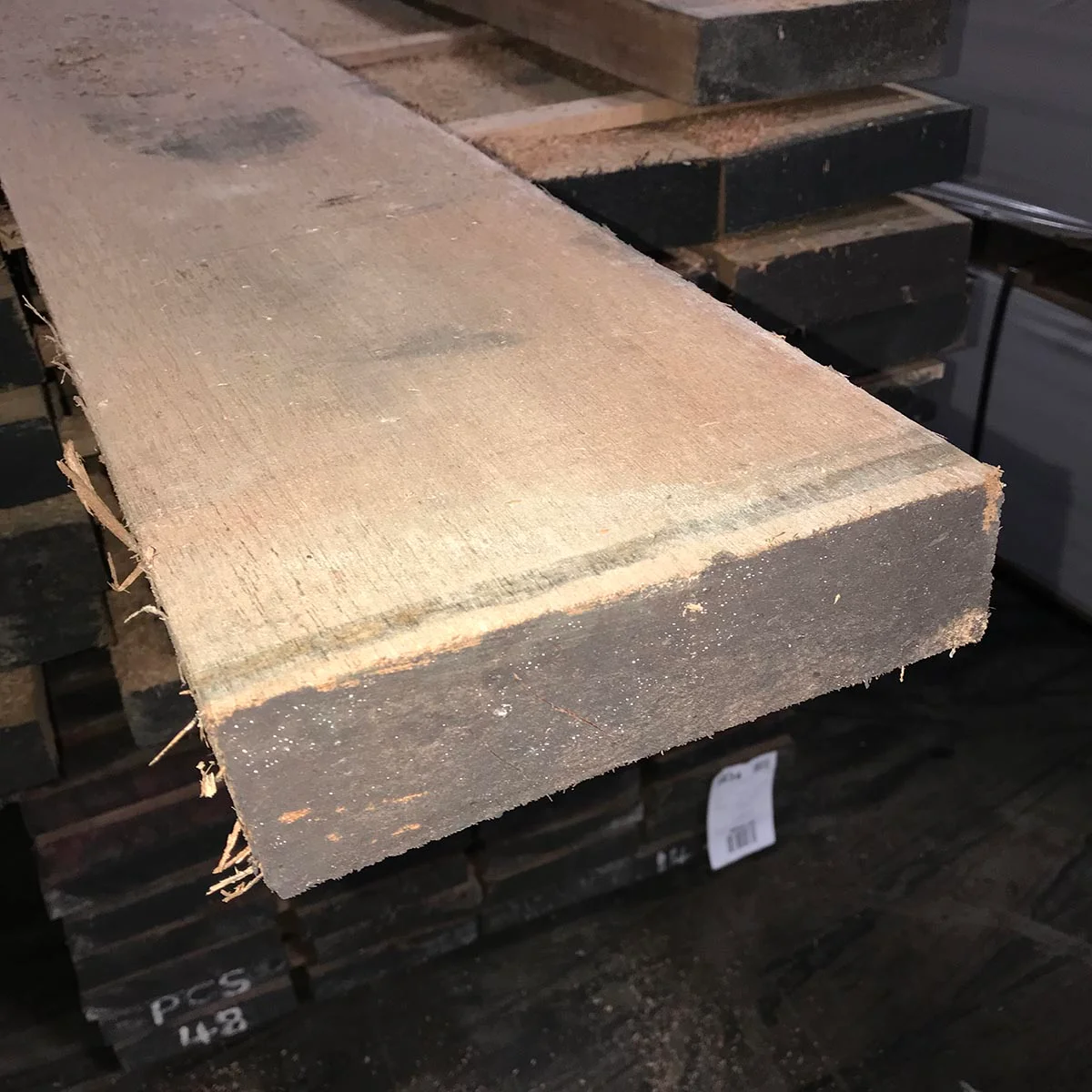
This is the profile most lowboys and heavy drop decks were built around. Replacing worn boards with the same general type of full-sawn material keeps the new floor consistent with the frame, cross-member spacing, and load pattern the trailer was designed for. The rough surface can also add grip for tracked or wheeled equipment; nobody wants their bulldozer sliding off the deck, trust us!
TrailerDecking.com stocks rough boards in Genuine Apitong (Keruing) and kiln-dried Angelim Pedra (Brazilian Apitong). Both are dense tropical hardwoods with a much higher modulus of rupture and side hardness relative to oak or softwood—properties that hold up under repeated equipment traffic and outdoor exposure.
Full-Sawn Dimensions and Fit
Rough boards leave the mill cut full to size. A board listed as 2x8 is a true two inches by eight inches, not the dressed 1½” to 1¾” × 7¼” to 7½” of standard dimensional lumber. In practice, pieces commonly run slightly over nominal, and some can measure as much as ¼ inch over. They are never intentionally undersized.
That variation is normal for full-sawn lumber, but it affects how the deck lays between rub rails, around stake pockets, and across the trailer width. Measure the existing floor and the frame openings before ordering. Worn boards lose surface thickness due to shrinkage and wear, so an old board that measures under its original size is not a reliable reference for what the trailer was built to accept. Check several pieces and note rub rails, cross members, and any recessed areas.
During installation, expect minor board-to-board differences. You may need to select and place boards deliberately, rip one or more pieces, or trim the final board so the deck does not bind against the frame. That fitting is part of working with full-sawn material; it is not a defect. You can plane down boards that are too thick, but we do recommend installation with the surfaced side down.
Surface Texture and Installation Notes
Band-sawn or rip-sawn faces show saw marks and feel coarse underfoot. On a working equipment trailer that texture is usually acceptable—durability and fit come first. The rough face does change the installation process: pencil marks are less crisp, fastener locations need careful layout, and raised fibers or splinters can catch gloves. Wear gloves, keep the deck clean enough to see your marks, and lay out the fastener pattern before drilling. Tropical hardwood slivers can be particularly nasty.
If the trailer carries loads that must slide, the added friction of a rough surface is a real factor. Tracks and tires often benefit from the grip; smooth cargo or specialized equipment may not. Match the surface to the work.
Rough Boards vs. Shiplap
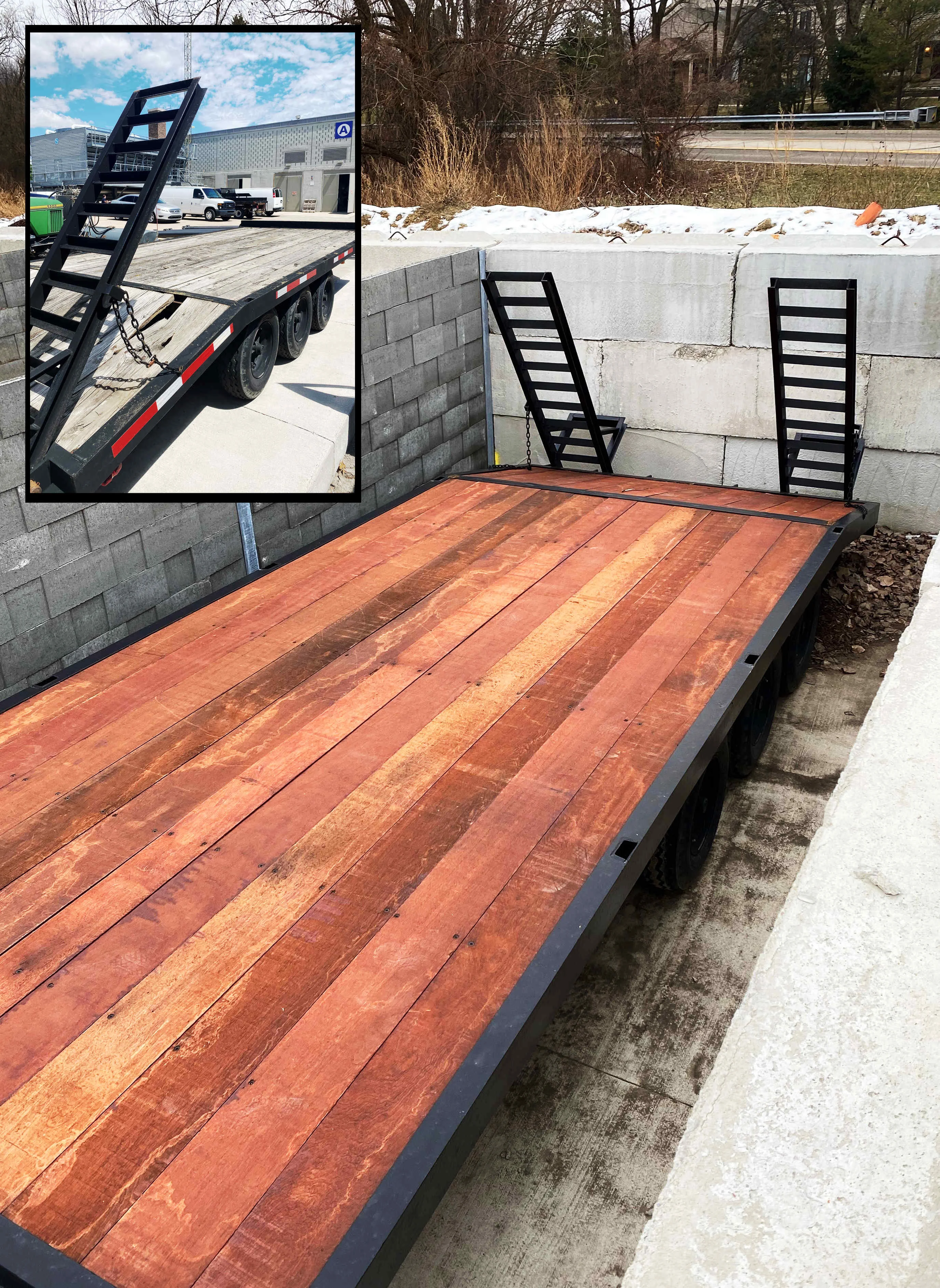
Shiplap is milled smooth on the faces and edges with a lap (sometimes called a Z-lap) that lets adjacent boards nest closely. It produces a more uniform surface and more predictable dimensions. It is the common choice for medium-duty flatbeds and platforms where a tight, relatively smooth deck is preferred and the original floor used that profile.
Rough boards skip the milled lap and the planed faces. The installer works with full-sawn faces and edges and the dimensional variation that comes with them. For heavy equipment work, that simplicity is an advantage when the trailer frame already accommodates thick, straight boards and an interlocking profile is not required.
Neither profile is universal. Match the replacement to the original floor design, the frame openings, and the cargo. On many lowboys the original specification was rough-sawn 6/4 or 8/4; on standard flatbeds it was often 1-1/8" or 1-3/8" shiplap.
Fasteners for Thick Boards
A heavy board only performs if it is fastened correctly to the understructure. Before you pull the old floor, note screw diameter, length, spacing, and the cross-member locations. Those details show how the manufacturer attached the original decking.
Screw length needs enough extra reach beyond the wood thickness to engage the steel properly. Short fasteners leave too little thread in the cross member; overly long ones are wasted and slower to drive. Trailer flooring commonly uses thread-cutting screws sized to the board thickness and the steel beneath it. TrailerDecking.com carries the OEM-style Type F screws in lengths from 2" to 4" to match common rough and shiplap thicknesses.
With dense hardwood, pre-drill and countersink. Correct pilot holes reduce bit wear and stress on the wood; a consistent countersink seats the head without crushing fibers around it. Lay out the pattern so every cross member is properly secured.
Planning the Order
Ordering rough decking is more than length times width. Random lengths, full-sawn tolerances, edge trimming, and the final board width all affect how much material the job uses. Measure the usable deck width, board thickness, approximate board width, trailer length, and any areas where the frame changes shape. Confirm that the replacement stock will fit the openings before the old floor comes off.
For jobs that need thick hardwood with a full-sawn profile, rough-cut boards in Apitong or Angelim Pedra are the practical choice. TrailerDecking.com stocks the common sizes from 2x6 and 6/4x8 through 2x12 and heavy 3x12 planks.
Choose the Floor for the Work
The right floor follows the work the trailer does and the structure underneath it. Rough-cut trailer decking is the right call when the application needs substantial board thickness, heavy point-load capacity, and a frame that accommodates full-sawn material without relying on a smooth interlocking profile.
If you are sizing a replacement, measure carefully and call 1-855-APITONG. We can help confirm dimensions, species, and fastener length so the order matches the trailer.